Preparing Students for Higher Ed or The Real World?

The title of this post shouldn’t be a question. Additionally, it shouldn’t contain an “OR”!

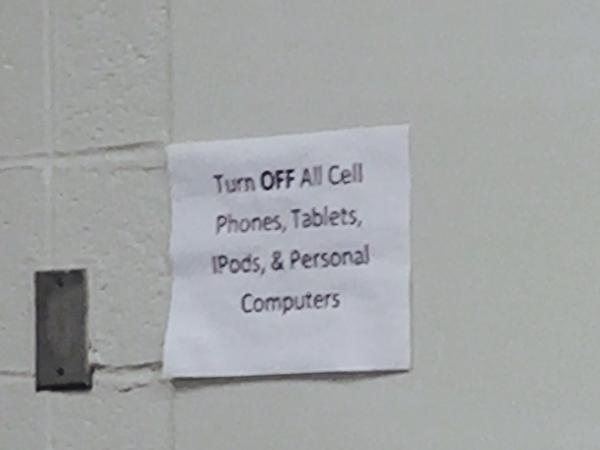
The photo above is of a sign hanging in a classroom at a well-respected university. The school itself doesn’t matter, because I am sure there are too many like it, in colleges and universities throughout the nation.

As K-12 schools, we are challenged to build the necessary skills students will need to be successful in the “real-world.” However, by now we know that our approach is often in conflict with what students need to be successful in higher ed. Notice, the set of skills is not the same for both. But it should be!

As a middle school principal, I constantly hear about how we need to do certain things differently, or in some cases, not provide certain supports, in order to “prepare our students for high school.” I usually respond by reminding people that our primary purpose is to educate our students in our curricular areas, and build the skills necessary to be successful in the workplace. In response, I often hear how we are setting kids up for failure. But why should we have to do things that are not in the best interest of student learning, just because high schools or colleges do them? I refuse to budge from making sure we are doing what’s best for students, regardless of what anyone else is doing.

So why do many high schools have different views on what’s educationally appropriate and necessary? Of course — It’s because of what colleges and universities deem educationally appropriate and necessary. But what if they’re wrong? What if many of our post-secondary institutions, who are notoriously slow to change, are not doing what’s best for students? What if they are still refusing to embrace the power of leveraging technology in and out of the classroom to engage students in a type of learning necessary to compete in the real-world? What if the professors in our universities have been out of real-world practice and have only been doing research and teaching college courses? What about the fact that many university professors are/were knowledgeable in their fields, but frankly are just poor teachers? Should they be setting the example for K-12 schools to follow?

To be honest, I’m tired. I’m tired and frustrated with higher ed dictating what high schools should be doing, and down the line. There are too many decisions influenced by higher ed that shouldn’t be. Grading practices would be the first one I’d like to throw out the window. But there are others.

Whether you are at the elementary, middle or high school level: How are you, or your school, negatively influenced by practices of schools at the level above you?

Making School Culture Our Focus

I have attended a few different conferences, workshops and EdCamps lately where I have been introduced to an amazing amount of ideas and strategies related to instruction, technology and innovation. These sessions have been inspiring and excellent educational learning experiences. However, an underlying tone that has existed in some of the sessions I’ve attended has related to school culture. In technology sessions I’ve heard concerns about trust and support. In curriculum or instruction sessions I’ve heard teachers express concern about not feeling safe to take risks or not having autonomy in their classroom to try new things. These concerns relate back to school culture.

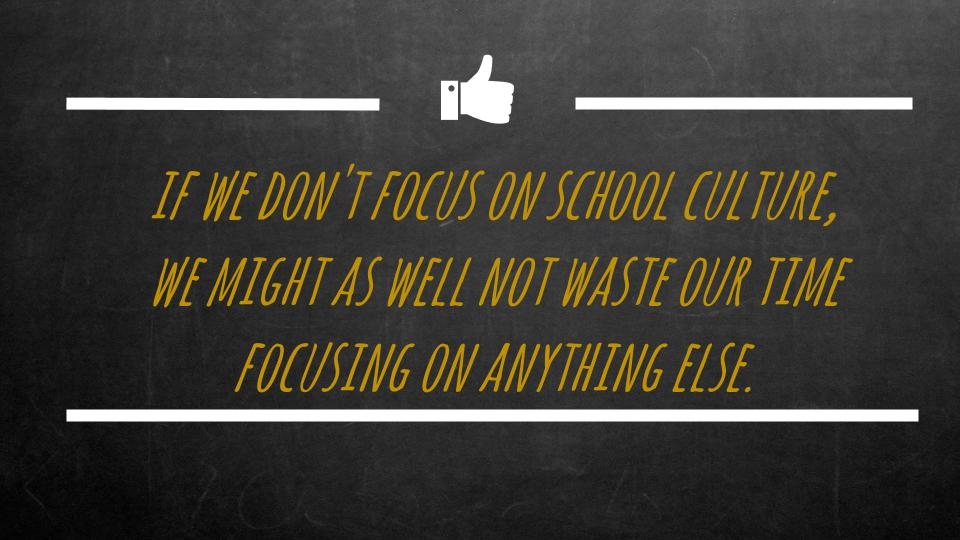
If we do not focus on a positive school culture first, attempts to lead change or incorporate innovative ideas and technology become that much more difficult, if not impossible. There are too many schools that constantly shove new initiatives and ideas onto teachers while simultaneously destroying the culture of the school. School leaders are so caught up with doing what they feel is urgent, like incorporating the latest tech, or introducing new programs to address test scores, they miss what is important and crucial, which is school culture. As leaders, we need to get our school culture in a good place before trying to lead change in other areas. Admittedly, I have not always been perfect in this area, and have learned a lot through my failures and experiences as a leader. However, I have seen the positive effects of making school culture a central focus (see my previous post). The challenge for me has been maintaining a balance between keeping school culture a central focus, but at the same time, incorporating some new ideas and strategies.

So why isn’t there more of a focus on school culture?

At conferences and EdCamps, why are there dozens of PD sessions on the latest Apps and Google tools (all of which are awesome), but little to no sessions or focus on school culture? I was recently asked by a participant in a school culture session I facilitated “How much of your administrative coursework was focused on building school culture?” My honest answer was “ZERO!” I am certain there are institutions and programs that address school culture, but how many make it a focus? How many programs communicate to leaders that building a positive school culture is the key to school improvement? We need to see more sessions at EdCamps, conferences and professional development sessions that focus on how teachers and leaders can build a positive school culture. We need more teacher and administrator preparation programs make school culture a central focus.

In Todd Whitaker and Steve Gruenert’s book School Culture Rewired, they write “Culture represents the unwritten mission of the school – it tells students and staff why they are there” (pg. 30). School culture is the central component of a school, it exists in some form – good or bad, and impacts everything within a school. We need leaders at the district and building levels to make improving school culture a top priority.

Improving Formative Assessment

Our school’s journey toward improving formative assessment begun two years ago with our faculty reviewing and discussing a list of Fundamental Instructional Practices (FIP’s). As a group, we chose formative assessment as the practice we felt was the most high-leverage and worth focusing our attention and professional development. Over the course of the next two years, our School Instructional Leadership Team (SILT) made up of 14 teachers and 2 administrators (@MurphyMusings5 and I) began to study, plan, implement, monitor and revise formative assessment definitions, frameworks and planning documents.

Establishing a Common Understanding

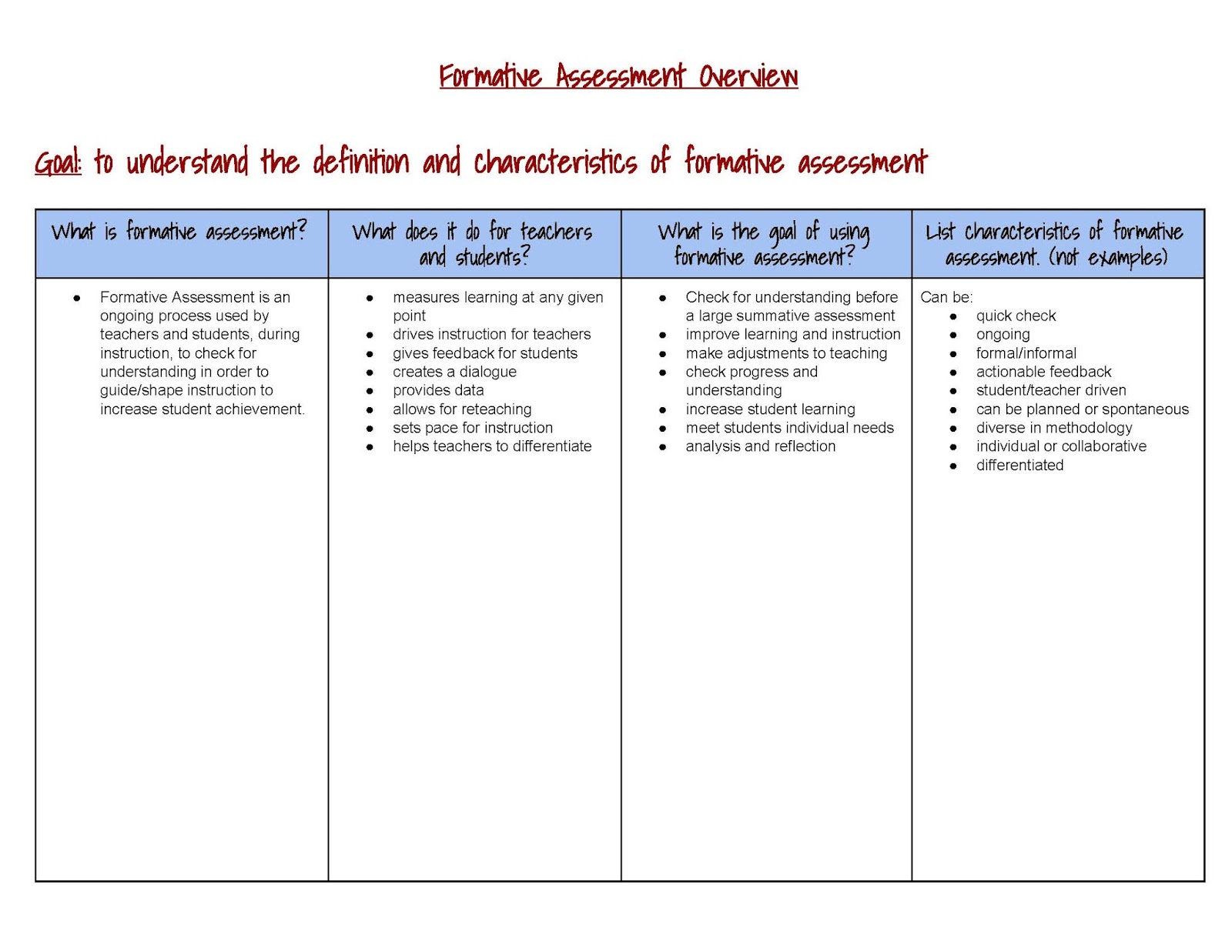
After our faculty chose formative assessment, we first had to build our common vocabulary on the topic of assessment. At a faculty meeting we compared summative and formative assessments, including definitions, characteristics, examples and non-examples. We eventually created a summary document we titled a Formative Assessment Overview. As a group, our common initial understanding of formative assessment was that it was something we did (check for understanding), rather than an ongoing process. Checking for understanding would become just one step in this process.
Developing a Framework

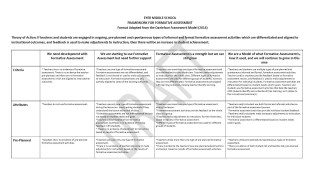
Over the next few months we also began to create a Formative Assessment Framework, including a working Theory of Action. This document is still in revision, but the goal is to create a framework to help guide us in the systematic evaluation of implementation. The framework would not be used to evaluate individual teachers, but instead, as part of the Instructional Rounds process which takes a systemic look at school-wide implementation of a specific practice.

Identifying a Process


After initially creating our formative assessment framework, it became evident to our SILT that although we kept referring to formative assessment as a “process”, we actually lacked the identification or formalization of this process.
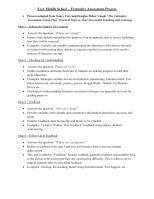

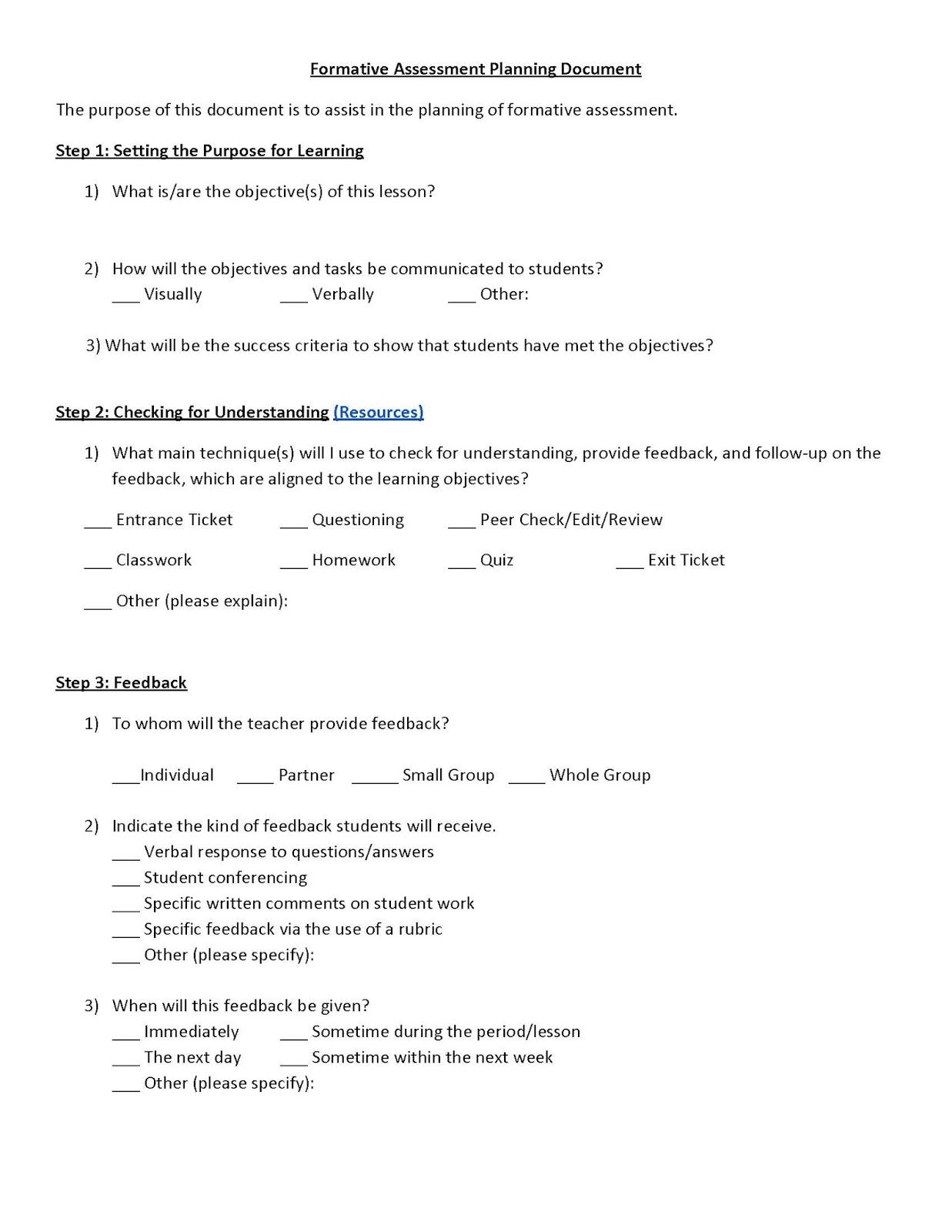
So now we needed a process. However, instead of attempting to develop this from scratch, we began reviewing books and literature on the topic and we found exactly what we were looking for in the book “The Formative Assessment Action Plan” by Nancy Frey and Doug Fisher. In their book, Frey and Fisher outline a practical four-step process for formative assessment. We immediately ordered copies of their book for our entire SILT and began our work to adapt their process to make it our own. We tweaked the names of the steps a bit, but ultimately stuck with the process. In addition, we worked with our faculty to create and revise a practical planning document that could be used to assist in their thought and planning process when designing formative assessment.

The process to create these documents and develop our understanding of formative assessments involved monthly meetings with our SILT, as well as the devotion of faculty meeting and professional development time. Many of these meetings were led by teachers who were part of our SILT. This was work we believed in and our teacher-leaders invested a lot of time and effort to ensure the high quality results that could be transferred into the classroom.

Back to Basics


After implementing the formative assessment process into classrooms throughout our building, through observations it became apparent that we could not accomplish steps 2-4 to a high degree of quality before we first were able to appropriately set the purpose for learning. Our course curricula lacked clear, specific, student-friendly learning objectives. If we were going to engage students in the formative assessment process, they first had to be able to understand the learning objectives. After modeling and sharing examples of student-friendly learning objectives, including the use of “I Can” statements, we allocated numerous hours of time during faculty meetings and professional development for teachers to write objectives for their courses. This involved reviewing curriculum, pacing guides, unit and lesson plans. Teachers worked together to create “I Can” statements for each unit in their curriculum and began to communicate them to students on a daily basis in their classrooms.

Modeling the Practice

As teachers began to implement the use of student-friendly learning objectives into their classrooms, building administrators modeled steps 3 and 4 of our formative assessment process by giving ongoing, specific feedback to individual teachers so they could continue to improve their practice.

Next Steps


Our next steps as a school include revising our Formative Assessment Framework to better reflect the four-step process we developed. In addition, our faculty survey feedback and observational data show that we need to spend professional learning time on methods and strategies related to Step 3: Feedback and Step 4: Follow-Up.


Reflection

During this two-year journey we have learned so much TOGETHER. I think this is the best outcome from this process and journey. A group of teachers (SILT) took a leadership role in improving instruction, engaged the faculty, and devoted an appropriate amount of time for the work. During this time, our school did not focus solely on formative assessment, but also on Questioning, Grading Practices and other topics. However, our formative assessment work is where we really invested ourselves and has helped us create a culture focused on improving instruction.

How does your school create a culture that focuses on improving instruction?
Positive Attitudes Will Succeed!

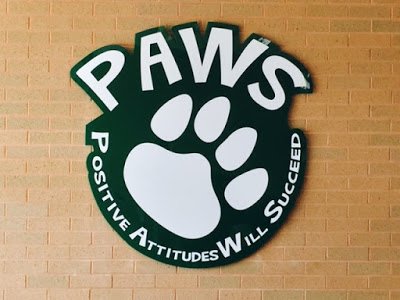
At our school, we believe that Positive Attitudes Will Succeed. Our middle school’s mascot is the bulldog and the “PAWS” (Positive Attitudes Will Succeed) acronym fits right into our school culture. As part of our program, students are recognized for their effort and behavior, such as being prepared for class, or exhibiting positive character traits, by receiving feedback and a “PAWS Sticker” which they place on a specific page in their agenda books. Teachers, bus drivers, cafeteria aides, office staff and administrators all have stickers they give, along with feedback, to students who exhibit positive behaviors or character traits. As an incentive, each student needs a minimum number of stickers, decided by each team of teachers, to participate in sports and activities at the end of the day during our reward period, called Dog Pound. In addition, at five points in the year we do a PAWS sticker count and 100 or more of our top earners can participate in a Tailgate, Pancake Breakfast (they can also bring a friend to this one), Bowling Party, Ice Cream Party or Pool Party. The key to our program is that we provide opportunities for all students to be recognized for their efforts. We have students from our multiple disabilities, emotional support, autistic support and all other classrooms in the school, participate in our PAWS activities. It is not always the same students, or the typical “Straight A” student, who are being recognized or rewarded. We focus on ensuring our program is inclusive of all students. We have a PAWS committee, comprised of students, parents, teachers, staff and administrators, which meet monthly to plan PAWS events and make adjustments to our program. The positive feedback we receive from both students and parents is overwhelming.

So what’s the problem?

Lately, I have read a lot of push back against positive reward systems in schools. There have been numerous posts about internal student motivation and whether it does, or should, drive them to succeed. I have heard multiple comments made about reward systems being detrimental to students, and I’ll be honest, I don’t get it.

I think rewards are getting a bad name lately. Whether it be gamification points in the classroom, professional development badging systems, FavoritesLikes or Retweets, a promotion, a raise, positive feedback from a supervisor, or a compliment from your spouse, people receive positive “rewards” in many ways which they appreciate and enjoy. Ultimately, it’s not the reward that is our motivator, but these rewards should not be painted as a bad thing, or detrimental to people. These things are good! I question when people write or speak about how they should not matter and are damaging to students. I am sure there are programs that are not ideal, but I see our, and many other, positive behavior programs working well everyday.

What’s My Motivation?

Internal motivation is something we want to foster in our students as they learn and grow. However, I also understand the needs of middle school students. The goal of our school’s positive behavior program is not solely to motivate students to behave in order to gain a reward, but to give opportunities for adults to provide specific feedback to students about successful character traits and behaviors. The motivation for student actions comes from many places, such as the relationship between the teachers and the students, parental influences, peers, or even internal drive. The reward is feedback and recognition of the positive efforts or behaviors students are exhibiting and I do not think it is a bad thing. In fact, I see the positive impact it has on our students on an everyday basis.

What are your thoughts about positive behavior programs?

A School Where Teachers Want to Work

“What makes a school a place where teachers want to work?” We posed this question to our faculty three years ago. The feedback we received was the catalyst for changes that would improve our school culture. To be completely transparent, the school I serve in has a history of success and good culture, so the changes we’ve made are not worthy of a complete “school turnaround” story. However, I do think they moved the needle into greatness.

The Survey

One of my goals is to help make a school where teachers want to work. When we surveyed our faculty with this one open-ended question, we received a long list of things that varied from very specific complaints (sometimes harsh and hard to read) to broad areas needing improvement. However, we were able to take this long list of feedback and classify it into the following seven categories:

  • Great Teachers
  • Great Students
  • Support
  • Staff Culture
  • Good Communication
  • Awareness of Student Needs
  • Shared Decision Making

The Follow Up

What we did next, I feel, was the most successful decision. We shared these categories, with all the feedback classified under them, with the faculty. We divided them into groups and asked them to help us develop solutions. Essentially, instead of a group of administrators sitting in a room and stressing over how “to fix” all these things, we asked the faculty to help us make improvements for the school. We took a risk and asked them to take ownership of the improvements. The results were outstanding!

Each group of teachers came up with a list of practical solutions to improve the school in all categories. They asked to classify committees, define their purpose, and improve the way they communicate their work to the rest of the school. They asked for improved communication of meetings, agendas, and professional development. They asked to be included in more building decisions and came up with ideas to ensure this happened. They suggested ways to increase support for our fast-growing population of students with special needs. They asked for more recognition of all staff members. The group’s solutions were specific and realistic. The staff was empowered to take complete ownership and leadership to improve our school.

The Follow Through

We immediately made some easy, practical changes. We also set the ball in motion to make some changes that would take a lot longer, such as developing new ways to include faculty members in leading professional development sessions (This year over 30% of faculty did so). Each year, we’ve made changes and have continued to survey our teachers, asking the faculty to respond to survey statements and rate each of the areas we categorized.

The Results

We have found continued improvement in all categories, including staff culture. The tone of the feedback has shifted from focusing on complaints to focusing on ideas and improvements. Each year, we share the results with our faculty. Our teacher leadership team reviews the data and feedback, and generates recommendations to improve our building.

This summer a group of teachers is creating a “welcome package” for our new hires, including a school t-shirt, mug, and a new, teacher-created, “Survival Guide.” Our faculty never ceases to amaze me with their leadership and commitment to taking ownership of their school and making it the best place it can be.

It’s amazing what results from asking just one question. What questions do you ask?

*Thanks to Erin Murphy (@MurphysMusings5) for her input on this post. Be sure to check out her blog:  Murphys Musings.

The Teacher Interview: A Principal’s Perspective

“That person must work at our school!” That’s what we want to be saying to our interview committee when a teacher candidate walks out of the room. We want to be thinking that our school cannot afford to have that person not working with us. This is the level of excitement we want to have when deciding to hire a new teacher. We want to feel like this person not only fits into our culture, but will bring something we don’t have, will move us forward, and will make us better.

It’s interview season! Time to get to work filling positions created by retirees, transfers, or if you’re lucky, additional staffing. Now the downside. All the paper screenings and computer algorithms in the world cannot always find us the best candidates. To me, you need to meet people, speak to them, and get to know them both professionally and personally. I need to learn much more about them then just their credentials (already read their resume), or what their favorite lesson was. I need to know about their attitude, guiding philosophies and what motivates them everyday.

This year, we’ve tossed around using some new questions such as “What is your life motto, or words you live by?; What’s your favorite song?; What leadership roles do you hope to fill at our school?; How do you stay current in the field of education?; How do you prove to your students they are important?” These questions are aimed at trying to get some insight into who the person is and what their attitude and mindset may be. Shawn Blankenship (@Blankenship_S) wrote a post that appeared on Connected Principals back in April, called “Teacher Interview Questions That Work“. The questions Shawn shares not only allow us to get to know about a teacher’s craft, but also allow us to see into their personality, attitude and desire to improve. They help us get a more complete picture of the person in whom we are investing.

Positive attitude, motivation, determination, innovative, growth-mindset, sense of humor, sense of caring… These are just some of the very important intangibles I look for in a candidate. What other attributes do you look for, and what creative questions do you use to try to seek them out in a teacher candidate?

The End of Marking Periods

In many schools, including the one in which I work, teachers have adopted great practices such as ongoing formative assessment, re-teaching, re-testing and allowing students to re-do assignments. However, even with the implementation of these successful grading and instructional practices, the old “learning clock” still counts down to the end of the marking period. It’s like trying to beat the sand timer in a board game. All learning must be complete before all the sand gets to the bottom on the hour glass, or it’s too late. So, why?

Why do we have a system that encourages teachers to race against the clock to jam in one last project or test before the end of the marking period. I would argue, we no longer need these arbitrary time limits for learning in our current system.

With instructional approaches such as standards-based grading, grading for mastery, objective-aligned assessments, re-takes, and re-do’s; Do marking periods create arbitrary time constraints on opportunities for learning? When marking periods are removed, we promote a growth mindset approach to learning, students can continue to strive toward mastery, being exposed to multiple ways of learning, as well as multiple attempts/methods to demonstrate their learning.

With the ability for parents to check grades online, at any time, the need to periodically update parents via report cards no longer exists. I know some will argue that not all parents have access grades online. However, for the sake of this blogpost, I am focusing on the majority. After all, more people own a cell phone than a toothbrush. Another argument against the removal of marking periods is that a new marking period gives students a fresh-start, or a clean slate. However, by implementing some of the practices I mentioned above (re-testing and re-do’s), students are constantly and continually given a fresh-start, and new chance at learning.

Another flaw in traditional marking periods is their equal weight. In our system, each of the four, 46 day marking periods, ends in a grade that is weighted equally. But any teacher will tell you that not all marking periods are created equally. When ten days in the third marking period (22%) are taken up by standardized-tests, how can teachers and students accomplish the same amount of learning as in the second marking period. However, our current system weights all marking periods the same when calculating a student’s final grade.

There is much more to consider when it comes to evaluating grading and assessment practices, however, the removal of marking periods is something worth more consideration.

What thoughts or ideas do you have about traditional grading practices that should be re-evaluated?

Update: Our school is currently (2015-16 school year) piloting a continual, year-long grading period for all our sixth grade courses. We have removed the traditional four marking periods and have one ongoing grading period. So far, so good! More updates to come in future posts.

What I Learned Designing Student Projects

* This blog post was co-authored by Erin Murphy (@MurphyMusings5; psumurphette.com)


As a former social studies teacher, I loved to design elaborate projects that required students to work together in groups to create something that looked REALLY cool. The students would often spend weeks, inside and outside of school, researching information and working on creative ways to present it to others. Although some of the results of these projects did look REALLY cool, the project itself didn’t really result in much high-level learning. Over time, I learned a few guiding principles to designing projects, which really improved the level of learning for students, and often saved a lot of instructional time. Here are a few things I’ve learned:

1) Identify the specific learning standards, anchors or objectives.

Start with the end in mind. Of course, we’ve all heard of the backward design model. However, this is a crucial question step that will guide the approach to other questions. When choosing objectives, make sure they are higher level objectives. Having students research information on a topic, put it into a PPT, Prezi, Poster, or any other presentation tool, isn’t very high level if they aren’t required to “DO SOMETHING” else with that information. For example, I use to assign a ‘President Project’ which required students to research and present a ton of information on an assigned U.S. President. The presentations looked cool, but all they accomplished were students proving they could find and present information. There was no evaluation, synthesis or higher-level thinking required. It was like a fancy book report. Very little meaningful or challenging learning was accomplished. Instead of having students research information and report it in some way (almost the equivalent of finding a pile of rocks and moving them from one side of the road to the other), have students answer a question based on their research. Have them evaluation the research or synthesize data or information and then answer a question or solve a problem. The big question is: What are students required TO DO with the information? If the answer is just, report it out using a fancy presentation tool, then it doesn’t meet criteria for a quality project.

2) Create an assessment criteria.

What will be assessed? How will it be assessed? How much point value will be assigned to this project? There are a few things to consider here. First, make sure you are assessing the identified learning objectives. Often times, teachers attribute points to cover pages, neatness, effort and other areas that are not aligned with the actual learning objectives. We can teach teach and model these things, but we need to make sure we are assessing and grading are the actual learning objectives. This is not to say that some point value cannot be allotted for things like neatness of a presentation, but it should be a very small percentage, as that usually was not the goal of the learning. If neatness, presentation skills, organization, design, etc will be assessed, be sure you have taught and modeled the skills. We cannot expect students to meet expectations for these elements, if we have not made them clear.  It’s not really fair to grade things we don’t explicitly teach.

Second, the number of points should be somewhat relative to the number and level of learning objectives the project assesses. Is it fair to give a 100 point test, which assesses 10 learning objectives, then assign 100 points to a project that only assesses three? This is something to consider when setting a point value. Just because it takes a week, doesn’t mean it must be worth more points. Try to find a balance. A clear rubric can help. Create a rubric that breaks down the assessment of learning objectives and sets values for different levels of mastery. Review the rubric with students and ask for their feedback prior to finalizing. You can also allow students to help create the rubric. I never did this as a teacher, but wish I would have. I learned about this idea last year and have heard of some great approaches and examples. One would be, to start with a project exemplar/model that would normally earn a “C”. Have students give input on what would improve it to a “B” and an “A”. Document and create the rubric based on their feedback. There are other ideas, but that is just one. Discussing, and not just reviewing, the rubric prior to giving to students to begin their projects is extremely valuable to improve clarity of expectations.

3) Set a timeline.

The timeline should be relatively based on the number of specific learning objectives the project will assess, and somewhat on the assigned point value. For example, if it only assesses two objectives, a three-week timeline is probably not appropriate. This was definitely an area in which I grew a lot over time. Some of my early projects would take weeks, yet only measure a couple, low-level objectives. Be sure to consider this when designing a project.

4) Determine Student Groupings.

Should this project be individual? Partners? Groups? Ask yourself, what are the benefits of each option. Make sure there is some rationale for your decision. For example, are there four somewhat equal parts that each student can do, and you can assess individually? If so, place the students in groups for four. When assigning group projects, make sure their are roles for each student that hold them accountable to the learning. This will not always be perfect, but one student should not suffer, or be rewarded, for the work of another. Individual assessment and fair grading are usually some of the biggest challenges to designing group projects.

5) Evaluate the need for Differentiation.

Projects lend themselves to differentiation. Differentiation should be based on student readiness, interest, or learning style. Differentiating the product is a good place to start… When assigning a question for students to answer, or a problem to solve, the available options for students to show their knowledge are many. Allowing students to choose their product is one way to differentiate. As the teacher, you can provide some options, but also allow for student choice. You can also differentiate content by assigning a series of questions, or problems, students can choose to answer or solve. Remember, WHAT (content, process or product) you differentiate should be based on WHERE your students are (readiness, interest, or learning style). A differentiated project increases student engagement, when it is appropriately rigorous and allows for student choice.

6) Stay involved.

Designing a project is hard work. While students work with their groups, it is tempting to spend this time catching up on other things: finally grading the papers put on hold while preparing this learning experience. However, this is when students need their teacher the most. It is imperative that we remain engaged with the students while they work on the project. In the design phase, brainstorm all of the mistakes or stumbles students might experience. Create a list of guiding questions to help keep the students focused and poised for success. If a project will last more than a few days, build in check points. “Elevator Talks” are a quick and easy way to measure group progress. Visit each group individually and randomly select one of its members. That student has approximately one minute – about the length of an elevator ride – to fill you in on their group’s progress. We recommend keeping these talks private, just you and the group. It will be important to model this experience with the class, first. Give an elevator talk about the previous day or a favorite TV show. Be sure to point out that the talk highlights the most important information, but saves the small details.

Designing projects that meet the learning and interest needs of all students is always a challenge. Please share any ideas or insights you may have on the topic.


*This blog post was co-authored by Erin Murphy (@MurphyMusings5; psumurphette.com)

Perfect Grading Practices In An Imperfect Grading World

Perfect grading practices don’t exist!

Through our school’s efforts to improve our grading practices, I have come to a few conclusions. First, there is NO perfect grading system. If you are looking for a grading approach that you cannot poke holes in, stop now. Whether it be a 100 point scale, or a 4.0 scale, there will always be a level of subjectivity. Secondly, it is frustrating that we have not yet come up with a way to consistently improve grading outside of the traditional 100 point scale. Standards-based grading has promises, but still some of the same flaws and subjectivity of the 100 point scale. Third, traditional grading may be the biggest farce in all of education. Grades are like hieroglyphics with no translation guide. From one classroom to the next, they have a different meaning. Our district follows the same grading scale to determine a student’s letter grade (ex:94-100 = A), however, they allow a teacher almost complete autonomy in how they determine what criteria get a student to that grade. The sad part is, this is common in most districts. In our school, we will continue working on improving our grading practices (we just uncovered the flaws in the ‘total points’ method), but I wish all schools would have figured out a better way by now. After all, these flaws aren’t new.

My beliefs on grading have been shaped largely by the likes of Rick Wormeli, Doug Reeves and other well-known educational gurus. My goals for grading are for them to communicate learning in a practical and accurate manner. In our world of Student Management/Online grading systems, this doesn’t always come easy. Lately I’ve been working with teachers on trying to fit a standards/objective-based grading approach into our 100 point scale district grading system This has not been easy. We have toyed with ways to convert a 4.0 scale to the 100 point scale, and vice-versa. We have discussed weighting different objectives based on level of skill required. We’ve debated the number of questions to ask in order to adequately assess a student on an objective. We have evaluated marking period timelines and how they limit an objective-based grading approach. We have evaluated a lot!

In the absence of the option to get rid of grades entirely, here are a few of my beliefs about grading which shape my work with teachers to improve our grading practices.

A student’s grade should accurately communicate what a student knows, understands and is able to do, in alignment with standards, anchors and/or objectives.

Summative Grades v. Formative Grades

Summative – grades in which a student has no additional opportunity to show learning.

  • Traditional Examples: Tests, Quizzes, Essays, Labs, etc…
    • A summative test, quiz or essay can always be made formative with the allowance of a re-take or re-do. If a retake/re-do, the student would then receive the new summative score they earn on the re-take or re-do, and the first score would be dropped. That score now accurately reflects what a student knows, understands and is able to do.

Formative – grades in which a student has additional opportunity to show learning.

  • Traditional Examples: Classwork, Homework, etc…
    • If we grade knowledge and skills formatively (classwork, homework), then again summatively, are we creating “duplicate grading?” Does the grade now accurately reflect what a student knows, understands and is able to do? If they performed the same on both, YES, if not, NO.
      • “Duplicate Grading” – grading the same knowledge or skills more than once. This could be through one or multiple methods. If I want to know if a student can demonstrate an understanding of the first amendment and I quiz them on it and they get it wrong. Then I allow them to do a skit that now shows evidence of their knowledge on the first amendment. I give them the grade from the skit and drop the grade from the quiz. You wouldn’t GRADE both, since that would communicate conflicting information on what that student understands about the first amendment. Multiple methods of, and opportunities for, assessment are good practice. However, the grade should reflect a student’s performance on only one.
    • How much should formative grades weigh on final grade?
      • I personally believe that a report card should reflect ONLY summative grades. However, I appreciate the need for flexibility, and would be okay with all formative assessments (combination of CW, HW, etc.) being worth one point less than a whole letter grade (ex: 8 points).
      • Remember, if a student does NO classwork or homework, but exhibits knowledge of all information and skills on a summative assessment (test), when classwork and homework grades are factored, does the final grade now accurately reflect what a student knows, understands and is able to do? OR, does it now represent something else?

Grading Behavior or Effort

  • Grading student behavior or effort is a tricky and an inappropriate practice. To grade things such as work ethic, effort, participation or behavior, when these things are not part of a curriculum, and usually not explicitly taught, is inappropriate. Teachers often to not present clear criteria for meeting expectations in these areas, which makes grading them very subjective.
  • There are better ways to motivate and encourage work ethic, effort, participation and behavior. Grades are not necessary for these things.

What successes, struggles or challenges have you faced while working to improve grading practices in your classroom or school?